A Look at Progress Quest: The Original Idle Game
Ever since I discovered it years ago, I’ve loved Progress Quest. It came out in 2002 as a parody of EverQuest and the emerging MMORPG boom. “Playing” it consists of creating a character, clicking “Sold!”, and then watching progress bars fill forever. It’s considered the original idle game. While there’s no actual interaction or gameplay, Progress Quest has a lot of hidden charm.
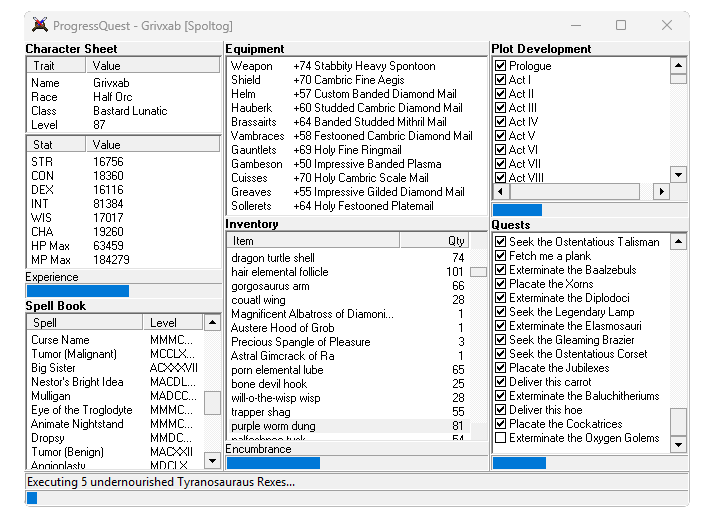
The game’s creator, Eric Fredricksen, built a whole RPG simulation into Progress Quest. There are 270+ monster varieties, procedurally named equipment, multiple storylines, intentionally weighted stats, real loot tables, an actual game loop and surprisingly complex progression. On top of that, there’s even an authentication system for competitive multiplayer leaderboards that are somehow still around today.
I love Progress Quest because of its absurdity, but also because it’s such a good example of something being far better than it needed to be. The amount of effort and attention to detail put into it makes me smile.
Exponential Progression
Progression in Progress Quest is governed by a single formula. The time it takes to complete level N is: (20 + 1.15^N) * 60 seconds. That means early levels take minutes (a few hours to get to level 10), while later levels take years. There is also additional time outside of leveling for the player to go to market, buy/sell things, and head back to the “killing fields”.
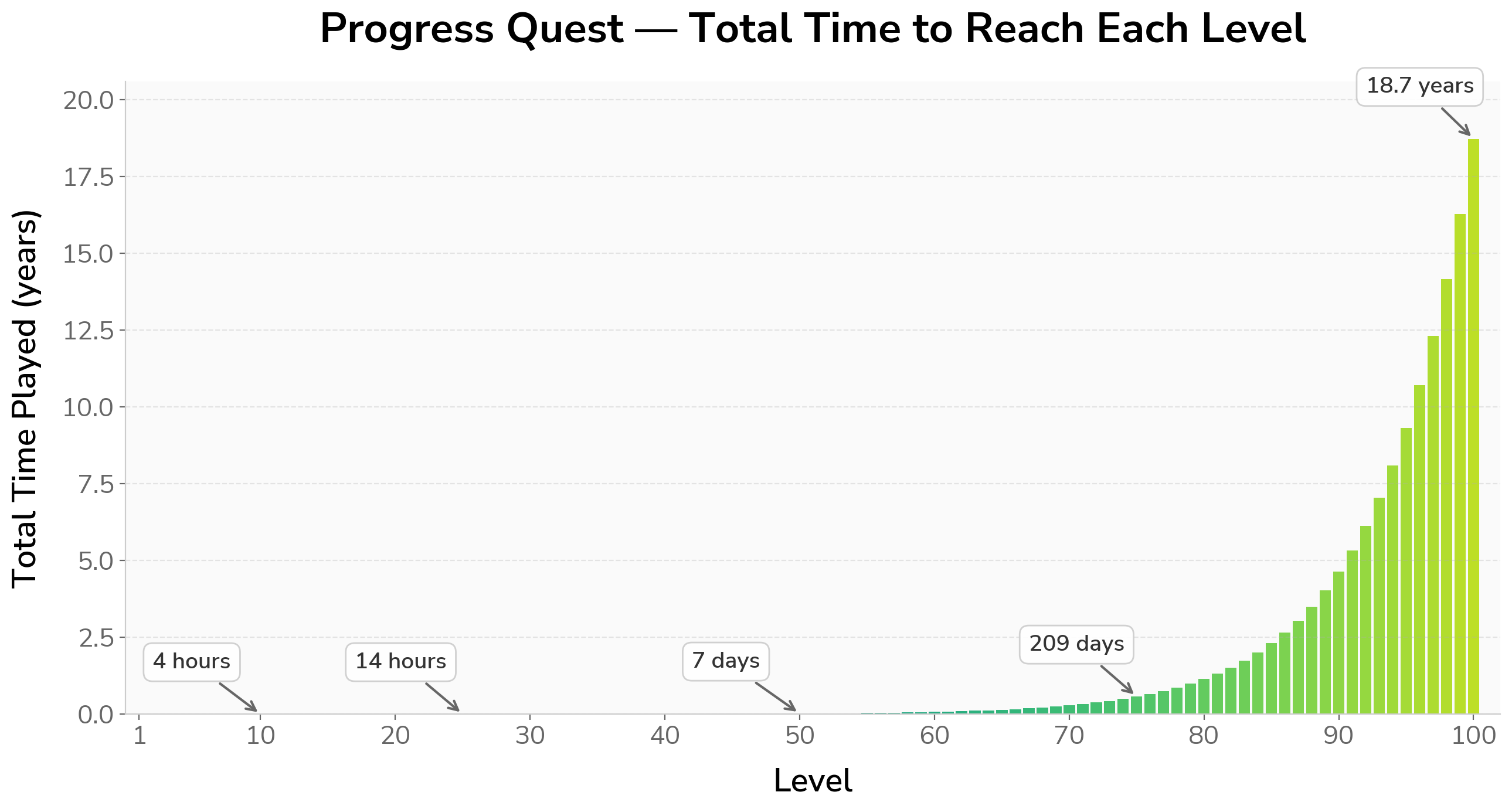
By my analysis, there are at least a few thousand active players across the remaining multiplayer realms. This is quite surprising considering it’s a 24-year-old idle game. Also, it’s crazy that any player above level 95 has had the game running for over a decade.
Races and Classes
The race and class systems are entertaining, but they don’t affect gameplay at all. The player races are: Half Orc, Half Man, Half Halfling, Double Hobbit, Hob-Hobbit, Low Elf, Dung Elf, Talking Pony, Gyrognome, Lesser Dwarf, Crested Dwarf, Eel Man, Panda Man, Trans-Kobold, Enchanted Motorcycle, Will o’ the Wisp, Battle-Finch, Double Wookiee, Skraeling, Demicanadian, and Land Squid.
The classes are: Ur-Paladin, Voodoo Princess, Robot Monk, Mu-Fu Monk, Mage Illusioner, Shiv-Knight, Inner Mason, Fighter/Organist, Puma Burgular, Runeloremaster, Hunter Strangler, Battle-Felon, Tickle-Mimic, Slow Poisoner, Bastard Lunatic, Jungle Clown, Birdrider, and Vermineer.
Hilarious Monster Types
There are over 270 hand-crafted monsters, and every one of them has a matching loot drop. Below are some of my favorites.
- Giants
- Humidity Giant (drops “drops”)
- Beef Giant (drops “steak”)
- Rice Giant (drops “grain”)
- Porcelain Giant (drops “fixture”)
- Mini Giant (drops “pompadour”)
- Golems
- Beer Golem (drops “foam”)
- Oxygen Golem (drops “platelet”)
- Cardboard Golem (drops “recycling”)
- Scouts
- Cub Scout (drops “neckerchief”)
- Girl Scout (drops “cookie”)
- Boy Scout (drops “merit badge”)
- Eagle Scout (drops “merit badge”)
- Elementals
- Bacon Elemental (drops “bit”)
- Cheese Elemental (drops “curd”)
- Hair Elemental (drops “follicle”)
- Porn Elemental (drops “lube”)
When the game picks a monster to fight, it level-matches against your character and then applies modifier prefixes based on the gap which adds more flavor to the monster names.
Generated Loot
When you get new gear, the game doesn’t just pull from a list. It runs a little algorithm:
- Pick a base item matched to your level from a list like Stick → Shiv → Longsword → Halberd
- Calculate the quality gap between the item’s base level and your level
- Spend that gap across up to two modifier adjectives
- Whatever is left becomes a numeric
+Nprefix
So a level 40 character might find a +13 Custom Holy Mithril Mail — a level 19 Mithril Mail base, with Custom (+3) and Holy (+5), leaving +13 unspent that gets added as a prefix.
The modifier tables are split into good and bad. If the gap is negative — meaning the item is actually better than you — the game pulls from the bad list instead: Rusty, Dull, Bent, Plastic, Nerf (-7), Rubber (-6).
There’s also a whole list of spells with names like “Holy Batpole,” “Grognor’s Big Day Off”, and “Roger’s Grand Illusion” that will make their way into your spellbook and increase in level with roman numerals.
The Main Game Loop
Surprisingly, the game has a real game loop. It works like this:
- Kill monster: The game generates a monster with a duration based on your level. When the timer finishes:
- Loot is added to your inventory, either a specific drop or generic loot
- XP is gained, which can trigger a level-up
- Quest and plot bars advance
- Check encumbrance: After a kill, if encumberance is at or above your limit, you go to market instead of fighting:
- The game will say “heading to market to sell loot”
- Then the game sells items one at a time, removing the top item in inventory and adding gold
- Items with “of” in the name sell for much more
- This continues until only gold remains
- Buy or head out: After selling, or if you weren’t encumbered in the first place:
- If the player’s gold is high enough to buy better gear, the game says “Negotiating purchase of better equipment” and the game upgrades a random equipment slot
- Otherwise the game will say “Heading to the killing fields”
- Next kill: After heading out, the game generates another monster and the cycle repeats
Stat Progression
When you gain a stat point, the game uses a weighted system biased toward your highest stat. Half the time, the gain is completely random. The other half uses quadratic weighting, where each stat’s chance is proportional to its value squared. That creates a snowball effect where your best stat keeps getting better, which feels authentic to how RPG builds tend to work.
The only real strategy to playing Progress Quest is rolling a high STR at character creation. Having higher STR gives you higher max encumberance which reduces how often you need to go to market. The thing is, the market trips are such a small fraction of actual game time that this only provides roughly a 5% advantage to your overall level up speed.
Never Stop Grinding
I can’t believe that Progress Quest is still somehow supported today and has an active player base. Equally impressive is the fact that the game has never been monetized in any way. I hope it somehow lives on forever.
If you want to play the “multiplayer” Windows version, you can download it here. I recently wanted to play again, and because it isn’t on Mac I vibe-coded a Swift version that runs on modern Mac hardware and works with the multiplayer leaderboard. See you on the killing fields!